
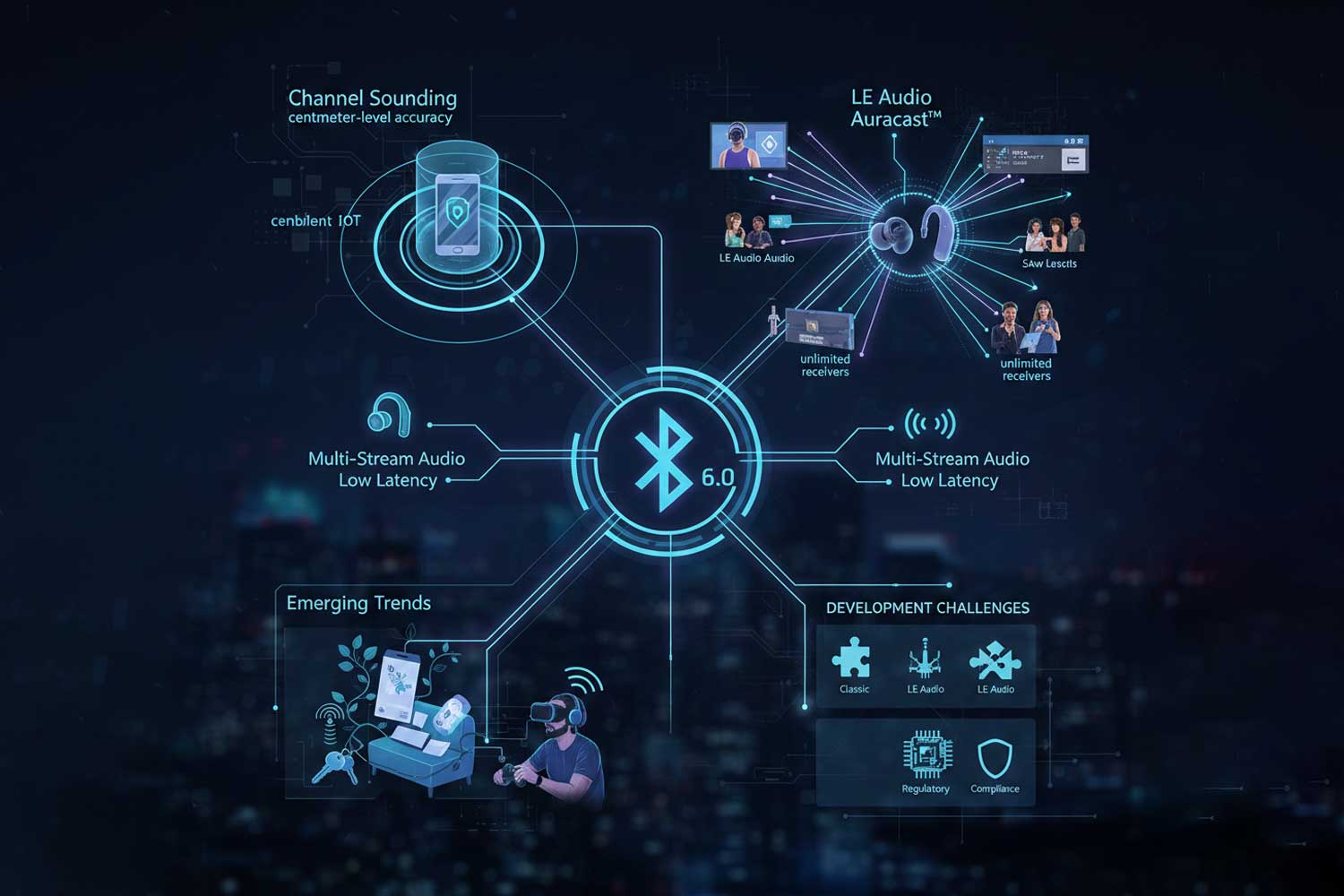
Bluetooth development in 2026 is undergoing its most significant transformation in a decade. The transition from “Classic” Bluetooth to Bluetooth 6.0 and LE Audio is redefining how we interact with sound, location, and the Internet of Things (IoT).
Here is a breakdown of the current landscape of Bluetooth development in consumer electronics.
1. Bluetooth 6.0: The Precision Era
The release of Bluetooth 6.0 (late 2024, with mainstream device adoption in 2025–2026) introduced a headline feature: Channel Sounding.
- Centimeter-Level Accuracy: Unlike previous versions that estimated distance using signal strength (RSSI)—which is easily blocked by walls or bodies—Channel Sounding uses phase-based ranging. This provides distance measurements accurate to within 10–30 cm.
- Security (Distance-Based Authentication): This prevents “relay attacks” on digital car keys and smart locks. The door will only unlock if the device is physically within a few centimeters, rather than just “in range.”
- Efficiency: Features like Decision-Based Advertising Filtering allow devices to ignore irrelevant packets, significantly extending the battery life of wearables and trackers.
2. The LE Audio Revolution (Auracast™): Bluetooth Low Energy (LE) Audio is currently replacing “Classic” Bluetooth audio. This isn’t just a minor update; it’s a fundamental change in the architecture of sound.
Key Technologies:
- LC3 Codec: Replaces the aging SBC codec. It delivers higher audio quality at half the bitrate, allowing for longer battery life in earbuds or higher fidelity in the same power envelope.
- Auracast™ Broadcast Audio: This allows one source (like a TV in a gym or an airport gate) to broadcast audio to an unlimited number of receivers (headphones, hearing aids).
- Multi-Stream Audio: Enables synchronized, independent audio streams to left and right earbuds, reducing latency and improving the “True Wireless” experience.
| Feature | Classic Bluetooth | Bluetooth LE Audio |
|---|---|---|
| Codec | SBC (High power, lower quality) | LC3 (Low power, high quality) |
| Connection | Point-to-Point(1:1) | Broadcast (1: Many via Auracast) |
| Latency | 100-200ms | ~20-30ms |
| Hearing Aids | Limited/Proprietary | Native Support |
3. Emerging Trends in 2026
- Ambient IoT: Developers are working on “batteryless” Bluetooth sensors that harvest energy from the environment (RF, light, or heat). These are being used for smart packaging and large-scale asset tracking.
- Find My Ubiquity: With Bluetooth 6.0, “Find My” networks are becoming precise enough to tell you which cushion your keys are under, rather than just which room they are in.
- Gaming & VR: The low-latency nature of LE Audio is finally making Bluetooth a viable alternative to 2.4GHz proprietary dongles for competitive gaming headsets.
4. Development Challenges: While the technology is advanced, developers face several hurdles in 2026:
- Fragmentation: Many users still own “Classic” Bluetooth devices. Developers must implement complex dual-mode stacks to ensure backward compatibility.
- Antenna Design: Bluetooth 6.0’s Channel Sounding works best with specific antenna configurations. Engineers must balance PCB space constraints with the need for multi-path robustness.
- Regulatory Compliance: New security standards for digital keys (like those from the Car Connectivity Consortium) require strict adherence to Bluetooth 6.0’s secure ranging protocols.

Leave A Comment
You must be logged in to post a comment.