
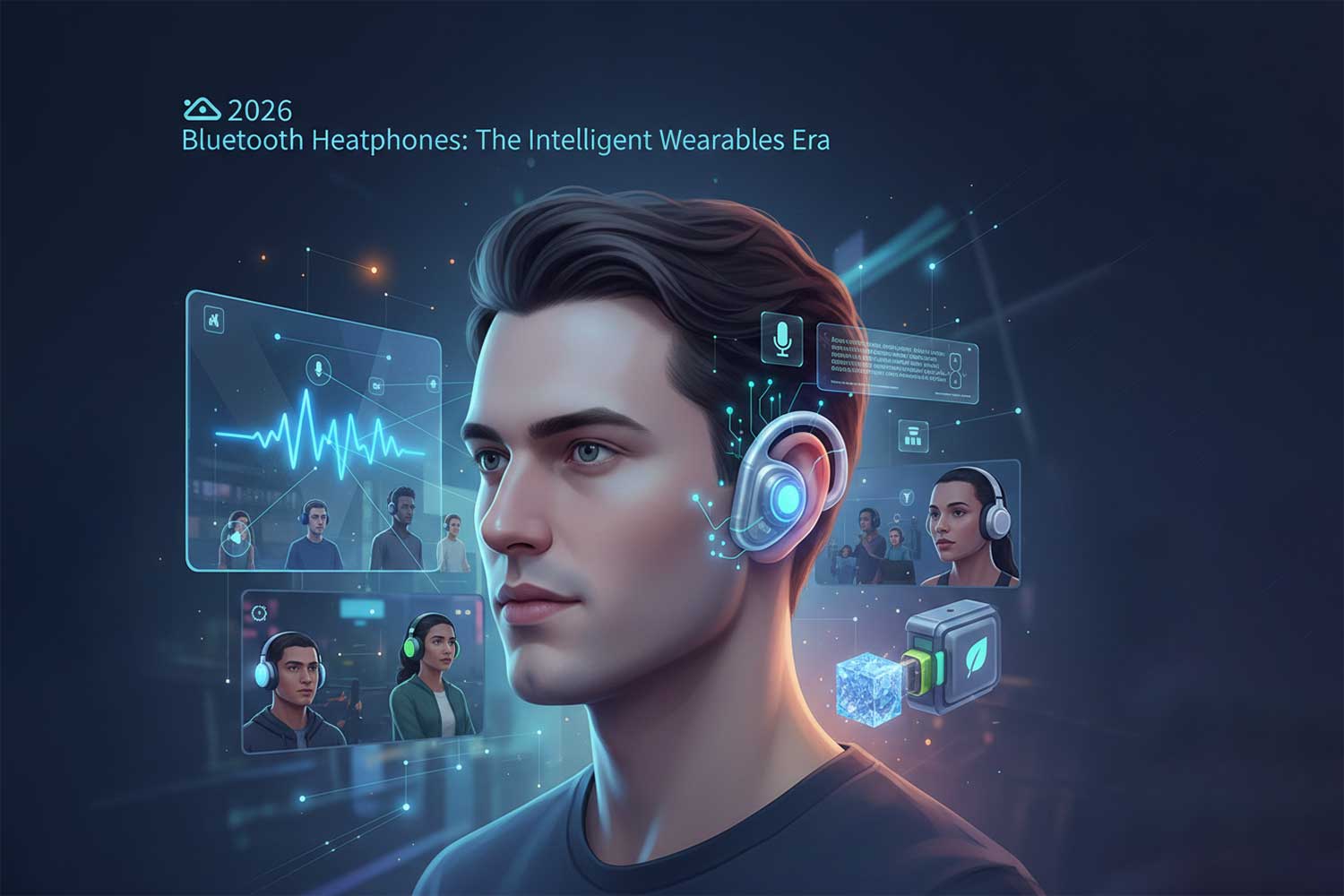
Nowadays, Bluetooth headphones have transitioned from simple audio accessories into intelligent wearables. The industry is currently defined by the maturity of AI-driven features, a shift toward “open-ear” comfort, and the widespread rollout of next-gen connectivity like Auracast. YERVIM’s research and development directions are as follows:
1. AI & Computational Audio: The “brain” inside the headphones is now as important as the drivers.
- Context-Aware ANC: Modern premium models shall use dedicated Neural Processing Units (NPUs) to analyze environments in real-time. They don’t just block noise; they intelligently filter it—letting through an emergency siren or a colleague’s voice while silencing background chatter.
- Real-time Translation: High-end headphones are increasingly serving as live translators, processing speech-to-speech translation with minimal latency.
- Adaptive Bass & EQ: AI now continuously adjusts the sound profile based on the fit of the earbud and the genre of music, compensating for seal leaks in real-time.
2. The “Open-Ear” Explosion: There is a massive trend away from “plugging” the ear canal, driven by comfort and safety.
- Air Conduction & Bone Conduction: YERVIM shall make a move toward “open-fit” designs that rest outside the ear.
- Hybrid Designs: YERVIM shall feature “shape-shifting” nozzles that can switch between an open-ear mode for running and a sealed mode for deep immersion.
- Health Monitoring: Because they are worn all day, “hearables” now include biometric sensors to track heart rate, body temperature, and even cognitive load (brain-sensing tech seen in prototypes from Neurable).
3. Connectivity Revolution: LE Audio & Auracast
Bluetooth 5.4 and LE Audio have become the standard, solving long-standing wireless issues.
- Auracast™ Broadcasting: This allows a single source (like a TV in a gym or an airport gate) to broadcast audio to an unlimited number of nearby headphones. You can now “tune in” to public screens just like joining a Wi-Fi network.
- LC3 Codec: This replaces the old SBC codec, providing higher audio quality at 50% lower bitrates, which has significantly boosted battery life (with many new models hitting 50+ hours of ANC playback).
- Ultra-Low Latency: Latency has dropped to the 20-30ms range, making Bluetooth headphones viable for competitive gaming without a dedicated USB dongle.
4. Hardware & Sustainability
- MEMS Drivers: We are seeing the first widespread use of solid-state Silicon (MEMS) drivers. These replace traditional coils and magnets, allowing for much thinner, lighter earbuds with faster transient response and clearer high frequencies.
- Modular Repairability: YERVIM is designing headphones with user-replaceable batteries and ear pads to combat e-waste.
Comparison Table
| Feature | 2024(Classic) | Future |
|---|---|---|
| Main Connection | Bluetooth 5.2/5.3 | Bluetooth 5.4 + LE Audio |
| Battery Life | 20~30 Hours (ANC on) | 45~60+ Hours (ANC on) |
| Latency | 100~200ms | 20~40ms |
| Audio Sharing | Limited(1 or 2 devices) | Auracast (Unlimited Devices) |
| Primary Tech | Dynamic Drivers | Hybrid MEMS + AI Processing |

Leave A Comment
You must be logged in to post a comment.